


North River Wealth - 1Q 2026 Market Recap
How Did Markets Do in the First Quarter of 2026?
That’s a loaded question. What began as a continuation of last year’s positive momentum quickly gave way to increased uncertainty and heightened geopolitical tension. In just the first three months of the year, we’ve seen continued AI-driven disruption in the software industry, a Supreme Court decision striking down tariffs and adding to trade uncertainty, and a war in Iran that triggered a sharp spike in oil prices.
January
Stocks kicked off the year on a solid note, fueled by ongoing excitement around AI and encouraging signs that inflation is cooling (which we know now was short-lived). Along the way, markets hit a few bumps as headlines around the Fed, geopolitical tensions, and mixed bank earnings created some short-term noise. Still, steady economic data and a softer tone on trade helped keep investors optimistic. By the end of the month, money was flowing back into large-cap tech, helping push the S&P 500 to new highs. Under the surface, though, leadership continued to broaden (which was a welcomed and encouraging sign), with a number of sectors and international markets participating, even as areas like financials and tech lagged behind.
February
Stocks had a tougher time in February, giving back some ground as concerns around how artificial intelligence could disrupt certain industries started to weigh on investors. The month began on a strong note, with the Dow even crossing the 50,000 mark for the first time and consumer sentiment improving. A softer inflation reading provided a brief lift, though markets came under pressure again late in the month as geopolitical tensions in the Middle East picked up. Even with the overall pullback, there were still pockets of strength, with more defensive sectors and international markets holding up relatively well.
March
And then there was March. The war in Iran sparked higher oil prices and caused fear in markets globally. The market sold off, bond yields surged, gold tumbled as energy and oil stocks surged. The market did recover on the last trading day of the quarter as hopes that the Iran war would end sooner than later.
Overall, most markets finished in negative territory for the first quarter of 2026. The S&P 500 (large U.S. companies) finished down 4.3% for the quarter, however the Russell 2000 (smaller U.S. companies) eked out a gain of almost 1%.
Across sectors, energy stocks significantly outperformed all other sectors while financials, consumer discretionary and technology stocks fared among the worst. Across the pond, the MSCI EAFE (developed Europe and Asia) finished down 1%, while the Emerging Markets were nearly flat.
In the bond market, the Bloomberg Barclays U.S. Aggregate Bond Index showed little movement during the quarter, while the 10-year US Treasury bond moved from 4.16% to 4.31%.
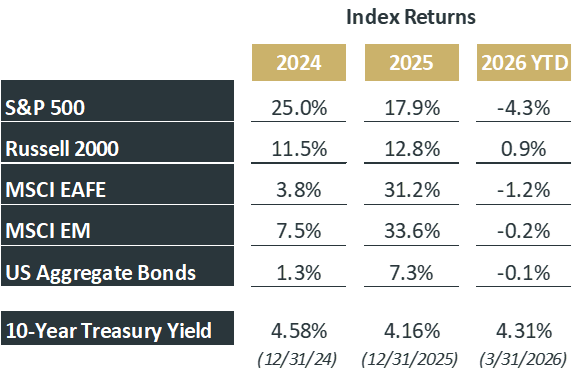
Source: Blackrock
The Fed
The Federal Reserve kept interest rates the same for the second meeting in a row, which is what most expected. They’re trying to balance unemployment and inflation with growing uncertainty from rising energy prices.
Overall, not much changed from their last update, but they did point out that it’s hard to know exactly how these global issues will affect the economy. Their latest outlook shows inflation coming down, but more slowly than hoped.
After a lot of discussion about possible rate cuts over the past year, there’s now even some talk about rates potentially going up instead. That said, the market is currently expecting little to no change in rates for the rest of the year.
Fed Chair Jerome Powell said progress on inflation is happening, just gradually. He also noted some uncertainty around leadership at the Fed, as his term is getting closer to ending and replacing him may not be straightforward.
Other Interesting Nuggets
- There is talk that the SEC may do away with quarterly earnings mandates and move to semi-annual filings.
- Investment grade bond issuance reached record highs in March as many companies fear rates could rise further.
- In March, gold fell ~20% from its all-time high in January.
- Meanwhile, the “Magnificent 7” stocks briefly fell into correction territory, meaning they dropped more than 10% from recent highs (for context, a bear market is defined as a decline of 20% or more).
What’s Next for Markets in 2026?
There are a lot of open questions right now.
- How long will oil prices stay high, and will that push inflation up enough to slow consumer spending this summer?
- Is this the start of more geopolitical tension, or will things settle down?
- When the market does rebound, will AI stocks lead the way again, or will we continue to see broader participation like we did earlier in the year?
- What’s next for the dollar after its recent drop, and could higher oil prices actually benefit the U.S., given that it’s a net exporter with a more tech-driven economy?
- While oil shocks tend to be short-lived, periods like this can still feel frustrating and uncertain.
At the end of the day, it all comes down to your risk tolerance, time horizon, and what you need your money to accomplish. While it will be interesting to see how markets respond to ongoing geopolitical tensions, we expect things to stabilize over time… it’s just a question of when.
Authored by Stephen Blahovec and Michael Rausch of North River Wealth Advisors. We are an independent, fee-only financial planning and investment management firm located in Pittsburgh, PA servicing clients locally and across the country. To learn more, contact us here.
This content is developed by North River Wealth Advisors from sources believed to be providing accurate information. Please consult legal or tax professionals for specific information regarding your individual situation. The opinions expressed and material provided are for general information and should not be considered a solicitation for the purchase or sale of any security.