


North River Wealth - 2Q 2026 Market Update
Like a hydration break during the World Cup, we took a brief pause from serving clients to catch our breath and recap what happened in the markets during the second quarter. Let's dive in.
How Did Markets Do in the First Half of 2026?
At the end of our first-quarter recap, we highlighted a handful of questions we were watching closely. Let's see how they played out during the second quarter.
Q: How long will oil prices stay high, and will that push inflation up enough to slow consumer spending this summer? A: Ask your neighbor who is driving to the beach later this month if gas prices have come down. Technically, they have…just not by much.
Q: Is this the start of more geopolitical tension, or will things settle down? A: If we had to summarize the last three months in a few words: more, then less, and now likely more again. Geopolitical uncertainty remained a constant theme throughout the quarter and continued to be a source of potential market volatility.
Q: When the market does rebound, will AI stocks lead the way again, or will we continue to see broader participation like we did earlier in the year? A: While many AI-related companies and semiconductor stocks continued to perform well, the story of the second quarter was broader market participation. Looking beneath the surface, gains extended across multiple sectors, market capitalizations, and regions and were not limited to large tech companies.
Q: What’s next for the dollar after its recent drop, and could higher oil prices actually benefit the U.S., given that it’s a net exporter with a more tech-driven economy? A: In the second quarter of 2026, the U.S. dollar bounced back and strengthened against many global currencies.
April: Markets Rebound on Easing Tensions and Strong Earnings
April was a strong month for U.S. stocks as investors responded positively to easing geopolitical tensions, encouraging economic data, and better-than-expected corporate earnings. Hopes for a lasting ceasefire in the Middle East and efforts to reopen the Strait of Hormuz helped calm investor concerns and fueled a broad market rally.
A stronger-than-expected jobs report and solid retail sales pointed to continued resilience in the U.S. economy, helping reassure investors that consumer spending and the labor market remain healthy. When first quarter earnings were released, companies continued to exceed expectations with approximately 85% of companies beating earnings estimates (source: J.P. Morgan), providing fuel for a market rebound in the second quarter.
May: Markets Build on Momentum Despite Continued Volatility
Markets continued their strong run in May, reaching several new record highs despite ongoing volatility. Investor optimism was fueled by encouraging economic data, strong corporate earnings (particularly from large technology companies) and continued diplomatic efforts aimed at reducing tensions in the Middle East.
Technology once again led the way as enthusiasm surrounding artificial intelligence and semiconductor companies helped push the Nasdaq to another month of impressive gains. A stronger-than-expected jobs report reinforced the view that the U.S. economy remains resilient, while declining oil prices provided additional support for both consumers and businesses. By the end of the month, all three major U.S. indexes (S&P 500, Nasdaq, Dow) had reached multiple record highs.
June and Quarter-End: A Strong Finish to the Quarter
The second quarter delivered strong returns across both U.S. and international markets as investor confidence improved and market participation broadened. The S&P 500 gained 15.2% during the quarter, bringing its year-to-date return to 10.2%. While large-cap technology companies remained important contributors, the rally expanded beyond the largest names as smaller companies and international markets also posted impressive gains.
Small-cap stocks were a standout performer, with the Russell 2000 rising 21.5% in the second quarter and 22.6% year-to-date, reflecting optimism that a resilient economy could continue to support smaller businesses.
International markets also delivered strong results, with emerging markets leading the way. Emerging Markets Index gained 24.1% during the quarter and 23.9% year-to-date, while developed European and Asian markets posted solid gains of 10.8% for the quarter and 9.4% year-to-date.
Bonds were relatively quiet during the quarter as interest rates remained elevated. The Bloomberg U.S. Aggregate Bond Index gained 0.7% during the quarter and 0.6% year-to-date, while the 10-year Treasury yield ended the quarter at 4.42%, slightly higher than where it began the year.
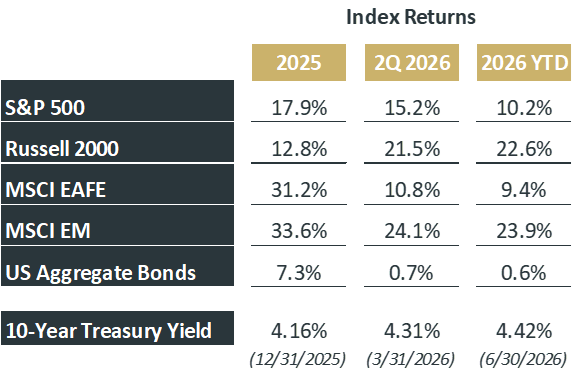
Source: Blackrock
Federal Reserve Update
The Federal Reserve kept interest rates unchanged throughout the second quarter, maintaining the federal funds target range at 3.50%–3.75% as policymakers continued to balance persistent inflation against a resilient economy. While rates remained steady, the quarter marked an important leadership transition as Kevin Warsh succeeded Jerome Powell as Chair of the Federal Reserve.
Although no policy changes were announced at his first meeting in June, Warsh reaffirmed the Fed's commitment to its 2% inflation target (when are we getting back to that?!) and emphasized a data-driven approach as Fed officials continue to monitor inflation, economic growth, and geopolitical developments. As of this writing, the market is expecting 1 to 2 interest rate hikes before the end of the year.
Is Inflation Becoming a Concern Again?
Inflation moved higher in May, with the Consumer Price Index (CPI) increasing 4.2% from a year earlier, which was the fastest annual pace in three years. Higher energy prices were the primary driver, as oil prices surged following heightened tensions in the Middle East. Gasoline prices also increased sharply, putting additional pressure on household budgets.
Despite higher prices, consumer spending has remained relatively resilient. While many households continue to feel the impact of inflation, strong employment, rising incomes, and spending by higher-income consumers have helped support overall economic growth.
What’s Next for Markets in The Second Half of 2026?
Here are the key questions as we enter the second half of 2026:
- Can the market build on its strong second-quarter momentum?
- Will artificial intelligence, semiconductor, and technology stocks continue to lead the market?
- Will market leadership continue to broaden beyond large-cap U.S. stocks to include small-cap and international markets?
- Where are inflation and interest rates headed in the second half of the year?
- Will geopolitical tensions in the Middle East continue to ease, or will renewed conflict create additional market volatility?
Authored by Stephen Blahovec and Michael Rausch of North River Wealth Advisors. We are an independent, fee-only financial planning and investment management firm located in Pittsburgh, PA servicing clients locally and across the country. To learn more, contact us here.
This content is developed by North River Wealth Advisors from sources believed to be providing accurate information. Please consult legal or tax professionals for specific information regarding your individual situation. The opinions expressed and material provided are for general information and should not be considered a solicitation for the purchase or sale of any security.