


North River Wealth - 3Q 2026 Market Update
Let’s first check in on some of the questions we asked at the end of the first half of the year and see where markets are heading as we head into the holidays:
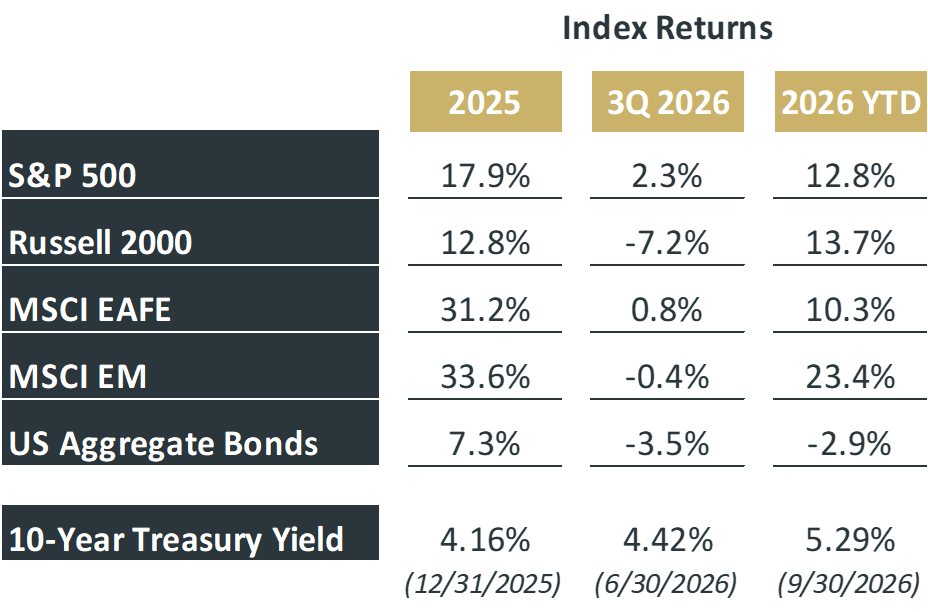
- Could markets build on their earlier momentum? U.S. markets were mixed during the third quarter. The S&P 500 and Nasdaq finished higher, while the Dow and small-cap stocks declined. Major indexes reached record levels during the quarter, despite periods of volatility.
- Did AI, semiconductor, and technology stocks continue to lead? AI and technology stocks remained important drivers of the market, supported by strong corporate earnings and continued investment in AI infrastructure. However, technology stocks experienced a sharp selloff in July before recovering in August and September.
- Did market leadership broaden beyond large-cap U.S. stocks? Market leadership remained concentrated in large-cap U.S. companies. Small- and mid-cap stocks struggled late in the quarter, while international markets offered mixed results. Energy stocks also outperformed many other U.S. sectors.
- Where did inflation and interest rates stand? Inflation remained well above the Federal Reserve’s 2% target, with rising energy prices adding to inflation concerns. The Fed raised interest rates in September for the first time since 2023, while Treasury yields climbed as markets adjusted to the changing interest rate environment.
- Did geopolitical tensions in the Middle East ease? Not yet and it does not look like things are changing soon. Geopolitical tensions remained a significant source of market uncertainty during the quarter. The continued conflict involving the U.S. and Iran pushed oil prices higher, contributing to concerns about energy costs, inflation, and the potential impact on the global economy.
July: A Mixed Month for Markets
Markets were mixed in July as investors weighed inflation data, geopolitical developments in the Middle East, and second-quarter corporate earnings. The Dow finished slightly higher, while the S&P 500 was nearly flat and the Nasdaq declined as technology stocks faced pressure from concerns about AI spending. Energy was the strongest U.S. sector, posting double-digit gains as oil prices rose, while technology stocks experienced notable declines. International markets generally moved higher, with European stocks posting solid gains and China’s market delivering a double-digit increase. The Federal Reserve held interest rates steady during the month.
August: AI Fuels August Gains
U.S. stocks moved higher in August, led by renewed enthusiasm for artificial intelligence and strong corporate earnings. The S&P 500 and Nasdaq posted solid gains, while the Dow rose more modestly. Energy and technology were the strongest U.S. sectors, benefiting from rising oil prices and continued demand for AI-related investments. International developed markets also advanced, although results varied across regions. Inflation came in slightly warmer than expected late in the month, while Federal Reserve Chair Kevin Warsh emphasized that bringing inflation back to the Fed’s 2% target remained a priority during the annual Jackson Hole economic retreat.
September: A Mixed Finish to the Quarter
U.S. stocks delivered mixed results in September, wrapping up a quarter shaped by technology earnings, economic data, and geopolitical developments. For the quarter, the S&P 500 and Nasdaq Composite posted gains, while the Dow Jones Industrial Average declined. Energy was the strongest-performing U.S. sector, as oil prices rose, while industrials, utilities, and consumer discretionary stocks faced greater pressure. International markets were also mixed, with gains in Brazil and China offset by declines in several European and Asian markets. U.S. economic reports showed stronger-than-expected second-quarter growth and a rebound in consumer spending, while housing activity remained uneven. Inflation continued to run, and the Fed raised its benchmark interest rate by a quarter percentage point in September, its first increase in three years, citing the need to bring inflation under control amid ongoing economic and geopolitical uncertainty.
Source: Blackrock
The Fed
The Federal Reserve raised its benchmark interest rate by a quarter percentage point in September, marking its first rate increase since 2023, as policymakers continued to prioritize bringing inflation back toward their 2% target. While inflation remains elevated, recent data showed price increases coming in below expectations, and the labor market and overall economic growth remained relatively resilient. However, rising oil prices and geopolitical uncertainty continue to complicate the inflation outlook. As of this writing, markets have priced in a nearly 90% chance of an additional rate hike at the Fed’s December meeting.
What does this mean for markets and consumers? The key takeaway is that the Fed is prioritizing getting inflation under control, even if that means keeping borrowing costs higher for longer. While the economy and labor market have remained relatively resilient, inflation is still above the Fed’s target, and rising oil prices add uncertainty. For consumers and businesses, this could mean continued pressure from higher borrowing costs, particularly for mortgages and other loans. The direction of interest rates will depend on how inflation and the economy evolve in the coming months
What Investors Will Be Watching in the Fourth Quarter
As 2026 draws to a close, investors will be watching several key developments that could influence both U.S. and global markets. Inflation, interest rates, bond yields, corporate earnings, and geopolitical events will all play a role in shaping market performance. The November midterm elections may also introduce uncertainty as investors assess potential policy changes and their implications for businesses and the broader economy.
Key questions heading into the final quarter include:
- Interest rates: Will the Federal Reserve raise rates again, or will cooling inflation give policymakers room to hold steady?
- The bond market: Will bond yields stabilize, or will persistent inflation and expectations for higher rates create further volatility?
- Artificial intelligence: Can AI-related companies maintain their momentum amid questions about spending, valuations, and the returns on AI investments?
- Midterm elections: How will the election results and potential changes in government policy affect U.S. and global markets?
- Inflation: Will price increases continue to moderate, or will higher energy costs keep inflation elevated?
- Geopolitical tensions: When will the U.S.-Iran conflict end, and what might that mean for oil prices, inflation, and global economic stability?
Authored by Stephen Blahovec and Michael Rausch of North River Wealth Advisors. We are an independent, fee-only financial planning and investment management firm located in Pittsburgh, PA servicing clients locally and across the country. To learn more, contact us here.
This content is developed by North River Wealth Advisors from sources believed to be providing accurate information. Please consult legal or tax professionals for specific information regarding your individual situation. The opinions expressed and material provided are for general information and should not be considered a solicitation for the purchase or sale of any security.